A radio purchase can go wrong before you ever press the transmit button. The handheld may belong to a different radio service from your friends’ equipment, the vehicle installation may need an antenna you have not budgeted for, or an impressive range claim may bear little resemblance to your local terrain. Radioddity offers plenty of affordable options, but its broad catalog rewards careful selection rather than buying by wattage alone.
This Radioddity review compares the GM-30, GM-30 Plus, DB20-G, and GD-AT10G around the questions that matter before ordering. It draws on official product listings, published purchase terms, US regulatory material, and selected customer accounts checked on October 29, 2026. No radios were physically tested for this article, so there are no invented range trials, audio impressions, or battery measurements. The focus is a practical buying assessment, with GMRS and amateur DMR kept clearly separate.
Radioddity at a Glance
Best for: price-conscious radio users willing to learn the settings and choose the correct service. Shortlist the GM-30 for basic GMRS handheld use, GM-30 Plus for added organization and receiving features, and DB20-G for a planned vehicle installation. The GD-AT10G suits a different buyer: a suitably licensed UHF amateur DMR user. Strengths include low entry prices and downloadable resources; limitations include setup complexity, conditional returns, and some inconsistent listing details. Overall assessment: worth considering, without a numerical performance score because no hands-on testing was conducted.
Start With the Right Radio Service
Compare GMRS handhelds, vehicle radios, and amateur DMR equipment before choosing a bundle.
Explore Radioddity Radios →What Is Radioddity?
Radioddity is both a radio brand and an online retailer. Its storefront includes its own handheld and mobile models alongside equipment from other brands, including Baofeng and Xiegu. That makes it useful for comparing different parts of the hobby, but it also creates an easy mistake: assuming everything sold in one store can communicate with everything else. Product family, permitted frequencies, operating mode, and local authorization matter more than the retailer’s name.
This review concentrates on US-oriented GMRS buying questions because three requested models are marketed for that service. The GD-AT10G belongs in the discussion because readers search for it, but it is not a GMRS upgrade. International shoppers should establish their own country’s equipment and operating requirements before importing. A US-oriented product listing does not establish permission to transmit elsewhere.
Key Features and Model Differences
| Model | Category | Published highlights | Buying priority |
|---|---|---|---|
| GM-30 | GMRS handheld | Up to 5W; repeater capability; USB-C battery charging; VHF/UHF reception | Affordable introduction |
| GM-30 Plus | GMRS handheld | Up to 5W; 1,000 memories in 10 zones; 2,500mAh battery; expanded reception | More organization and features |
| DB20-G | GMRS mobile | Marketed as 20W; detailed table lists 18W; external antenna connection; vehicle power | Planned vehicle installation |
| GD-AT10G | UHF analog/DMR handheld | Selectable output up to 10W; GPS/APRS features; 3,100mAh battery | Amateur DMR use, not GMRS |
Radioddity GM-30 review: the lower-cost starting point
The GM-30’s appeal is straightforward: a GMRS handheld with repeater capability and useful receiving functions at a low displayed price. Radioddity lists 30 GMRS channel entries and 219 programmable receive-only scanner channels. That is a memory arrangement, not 249 different GMRS frequencies. Its VHF/UHF reception also should not be read as authorization or capability to transmit across those bands.
The current listing advertises USB-C charging through the upgraded battery, front-panel adjustments, and CHIRP support. These are practical features for someone who wants more control than a fixed-channel consumer walkie-talkie. They also introduce a learning requirement: understanding tones, scan lists, and repeater settings. The product is most convincing when those controls solve a real need, rather than simply making the specification list longer.
Radioddity GM-30 Plus review: a feature upgrade, not a range promise
The GM-30 Plus keeps the handheld GMRS format while adding a published 1,000-memory capacity organized into 10 zones, a 2,500mAh battery, broader reception including airband, and GPS-related features. Organizing saved channels by trip or location can be more useful than scrolling through one long list. Its frequency-and-tone copy function may also make configuration easier, although every copied setting still needs checking. Receive coverage and memory count do not create new transmitting privileges.
The Plus is still advertised in the 5W class, so the reason to pay more is its feature set rather than an assumption of dramatically longer communication distance. Treat GPS tracking as a specific radio feature that needs compatible equipment and setup, not as a universal live map service. Likewise, airband reception does not make it an aviation transmitter. Check the manual for the exact behavior you expect before making either feature the reason for buying.
Radioddity DB20-G review: budget for the installation
The DB20-G moves the radio body out of your hand and places controls, microphone, and speaker in the handset. Its vehicle power lead and compact body make it relevant to convoy communication or a regular driving setup. Radioddity lists repeater support, scanning, and an external antenna connection. However, the title’s 20W label differs from the detailed table’s 18W figure, so this review does not present 20W as independently measured output.
Antenna planning is central to its value. The listed standard box contents include mounting hardware and a programming cable, but do not list an antenna; confirm your selected bundle. Budget for a suitable GMRS antenna, mount, cable, and appropriate installation. A more useful vehicle antenna position may matter more than a small difference in advertised transmitter power, and the quality of both ends of the link still counts.
Radioddity GD-AT10G review: a different kind of handheld
The GD-AT10G is a UHF radio supporting analog operation and DMR, with selectable advertised output up to 10W. Its listing includes GPS/APRS functionality, a 3,100mAh battery, and storage for a large DMR contact database. Despite “dual band” wording appearing in some page metadata, the detailed description identifies it as UHF-only. Do not buy it expecting a conventional VHF/UHF dual-band handheld.
This is for someone interested in configuring an amateur radio system, not someone seeking a simple substitute for a GM-30. DMR setup can involve contacts, talkgroups, color codes, time slots, and a compatible repeater or hotspot configuration. A GMRS license does not authorize amateur-band transmission. The GD-AT10G may be appealing for its particular feature set, but its higher output figure does not make it the best choice for an ordinary GMRS family group.
First Impressions, Design, and Setup
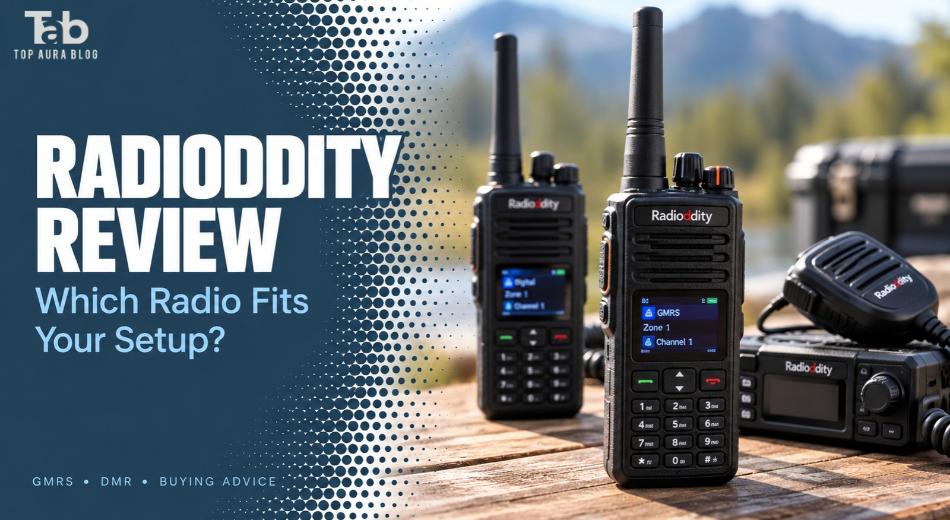
Official photos show keypad-based handhelds with displays and a compact mobile system with handset controls. Those layouts suggest different everyday workflows, but photographs cannot establish glove comfort, screen visibility in sunlight, or speaker clarity in a noisy vehicle. Packaging condition and accessory completeness also require a real delivery inspection. There is no implied unboxing or personal handling experience here.
The sensible first session is administrative as much as technical. Check the exact model, included accessories, battery condition, manual, and applicable operating authorization. Download the software and drivers intended for that model, and save a copy of the original configuration before changing settings. The current listings advertise CHIRP compatibility for the three GMRS models, but confirm the current supported model entry and use the correct cable rather than assuming every USB connection programs the radio.
For a group, a short shared channel plan often beats a long feature list. Agree on the channel, matching tone settings where used, a backup channel, and a time to check in. Test communication before the trip from realistic positions. A radio with hundreds of memories is less helpful than two correctly configured radios whose users understand the controls.
Real-World Performance: Set Expectations Around Terrain
Radioddity’s range figures are advertising claims, not results reproduced in this review. Hills, buildings, foliage, vehicle bodies, antenna position, interference, and the receiving radio all affect whether a conversation succeeds. A clear path between elevated positions is very different from communication through a dense neighborhood. Avoid choosing any handheld on a promised number of miles without knowing the conditions behind that number.
Higher power alone does not produce a proportional increase in distance. A vehicle installation with a suitable external antenna can offer practical advantages over a handheld used inside the cabin, but the other station must still be able to reach back. For camping, moving to a clearer position may be more effective than repeatedly transmitting from behind an obstruction. Actual route testing is the only way to establish whether your particular setup covers the places you need.
Repeater capability can extend useful coverage when a suitable local repeater is reachable, correctly configured, and available for your use. It is not included infrastructure: buying the radio does not give you a repeater network or permission to use every repeater you find. Check the owner’s access requirements and test before relying on it. A dead spot with no suitable repeater remains a dead spot regardless of the menu option.
Battery capacity is another planning number rather than a runtime guarantee. Transmission time, output settings, scanning, display use, battery age, and temperature all affect endurance. USB-C charging can simplify carrying chargers, but it does not establish charging speed or support for every power source. Test your chosen charging arrangement and avoid turning an advertised standby figure into an all-day operational promise.
Finally, CTCSS and DCS tones filter which signals open the speaker; they do not encrypt conversations or reserve a channel. Others can still hear a transmission with suitable equipment, and competing users can still occupy the frequency. Weather reception is useful where coverage exists, but receiving a broadcast and automatically producing an alert are separate functions. Verify the feature you need in the specific manual.
GMRS Licensing and Compatibility Before You Buy
For US operation, the current GMRS rules require an individual license and allow specified immediate family members to operate under that license. Applicants for a new individual license must be at least 18, and the normal license term is ten years. A group of unrelated friends should not assume one person’s license covers everyone. Check the current FCC application process and applicable rules before transmitting.
GMRS and FRS equipment can communicate on compatible shared simplex channels when settings match, but radio labels and channel numbers deserve checking. A GMRS radio does not become license-free simply because a nearby FRS radio can hear it. Amateur DMR is a separate service and configuration problem. Match equipment to the people you intend to talk to before comparing price, output, or battery capacity.
Pricing and Value for Money
The official storefront displayed these USD prices during research. Pack size, accessories, destination, taxes, shipping, and availability can change the final total. Delivery availability did not load in the retrieved product pages, so a displayed purchase button is not treated as verified stock for every address. Confirm your selected variant and destination at checkout rather than comparing headlines alone.
| Model | Displayed price snapshot | Costs or questions beyond the radio |
|---|---|---|
| GM-30 | $24.99 | Pack contents, programming cable, spare battery |
| GM-30 Plus | $36.99 | Variant, useful upgrade features, accessories |
| DB20-G | $109.99 | Antenna, mount, cable, installation |
| GD-AT10G | $169.99 | DMR setup, compatible infrastructure, accessories |
At those indications, the Plus is $12 above the original GM-30. That is a modest difference if the added organization or receiving features are useful, but unnecessary if you want only a shared GMRS channel for occasional outings. The DB20-G’s price should be compared as an installed system. An apparently dearer mobile package can become competitive once you account for an included antenna and mounting equipment.
Radioddity’s guarantee page states 18 months of coverage for qualifying new direct-store purchases, excluding separate arrangements for Xiegu products. It states one year for purchases through other platforms, with dealer terms potentially varying, and requires proof of purchase. Coverage is not transferable. That makes seller choice part of the value calculation rather than a detail to inspect only after a fault.
The return policy is less generous than an unrestricted trial. For unwanted unused items, its table lists no restocking fee in days 0–7, then 15%, 20%, and 35% across the later stated windows up to 60 days; returns beyond that are not accepted under that table. Shipping exclusions and return authorization apply, while defective or incorrect items have separate procedures. Confirm the timing and costs for your order before buying several models to test and return.
Compare the Full Purchase Cost
Check the exact pack, accessories, delivered price, warranty, and return terms before selecting a radio.
Check Radioddity Models and Prices →Radioddity Pros and Cons
| Advantages | Limitations |
|---|---|
| Low displayed entry prices for GMRS handhelds | Low price does not verify range or receiver quality |
| Handheld, mobile, and amateur options in one catalog | Different services and modes can confuse beginners |
| Published manuals and programming resources | Software, cables, and configuration need attention |
| Feature-rich Plus option at a modest price step | More memories and GPS do not guarantee better coverage |
| Documented warranty and return procedures | Restocking fees and shipping conditions affect returns |
| Mobile option for planned vehicle use | Antenna costs and inconsistent output wording need checking |
Who Should Buy Radioddity?
Radioddity is a sensible shortlist for a buyer who wants inexpensive equipment and is comfortable checking settings and documentation. The GM-30 can suit a straightforward GMRS group, while the Plus makes more sense when saved-channel organization and extra reception are valued. A regular vehicle user should examine the DB20-G as a complete installation. Amateur DMR users should judge the GD-AT10G against their actual local network and programming needs.
| Your situation | First model to examine | Before ordering |
|---|---|---|
| Basic licensed GMRS handheld use | GM-30 | Confirm group compatibility and pack contents |
| More memories and receiving features | GM-30 Plus | Decide which extras you will use |
| Vehicle-based GMRS communication | DB20-G | Plan antenna, power, and mounting |
| UHF amateur analog/DMR interest | GD-AT10G | Confirm licensing and network compatibility |
Skip a programmable handheld if you want the simplest possible controls and have no interest in managing settings. Buyers needing a documented environmental rating should verify the exact model’s documentation rather than infer durability from rugged styling. Anyone expecting guaranteed emergency coverage should build a broader communication plan. These radios can complement that plan, but their listings do not establish a monitored rescue service or dependable coverage everywhere.
Customer Feedback and Legitimacy
Is Radioddity legit? Its operating storefront, downloadable documentation, published policies, and substantial public review history support treating it as an established seller rather than an anonymous listing. That does not guarantee every order, unit, or repair experience. Confirm that you are using radioddity.com or a verifiable authorized seller, since a similar-looking domain is not evidence of the same business.
The customer accounts examined include praise for support resolving faults and arranging replacements. Other visible comments mention delayed replies or needing repeated clarification. Some examples concern other equipment sold by the store, so they inform a retailer-service discussion rather than proving GM-30 reliability. Brand-wide Radioddity reviews and model-specific performance reports answer different questions; neither provides a reliable failure rate from a small selection of posts.
Competitor Comparison: What Else Should You Consider?
| Option | Relevant manufacturer-listed feature | Why compare it? |
|---|---|---|
| Radioddity GM-30 / Plus | Budget GMRS handhelds with programming options | Low entry cost and feature choice |
| Wouxun KG-935G Plus | GMRS handheld; listed IP66 protection | Compare when documented dust/water protection matters |
| Radioddity DB20-G | Compact vehicle GMRS; external antenna required | Build a complete installation budget |
| Midland MXT275 | 15W GMRS mobile with control microphone; stock antenna included | Compare total package cost and interface |
Wouxun’s published IP66 rating gives shoppers a specific environmental specification to examine, rather than relying on appearance. It does not prove that it outperforms every Radioddity receiver. Midland’s MXT275 was listed at $199.99 with a stock magnetic antenna, making it a useful system-cost comparison against the DB20-G. There is no bench-tested winner here: compare equivalent packages, operating needs, and support arrangements.
Frequently Asked Questions
Are Radioddity radios worth buying?
They are worth shortlisting for buyers seeking low entry prices and programmable features. Choose by radio service, group compatibility, and complete accessory cost rather than advertised range. This review does not establish measured receiver quality or long-term reliability.
What is the difference between GM-30 and GM-30 Plus?
The Plus adds a larger published memory capacity, zones, broader receiving features, a 2,500mAh battery, and GPS-related functions. Both are marketed in the 5W GMRS handheld class. The upgrade is about features and organization, not a demonstrated jump in range.
Do Radioddity GMRS radios require a US license?
US GMRS operation requires the applicable individual license. Specified immediate family members may operate under that license, but unrelated friends should not assume they are covered. Check current FCC requirements before transmitting; other countries have their own rules.
Is the GD-AT10G a GMRS radio?
No. The official detailed description identifies it as a UHF analog and DMR radio intended for a different operating context. A GMRS license does not authorize amateur-band transmission, and it should not be purchased as a straightforward replacement for a GM-30.
Is the GD-AT10G dual band?
The detailed official description says UHF-only, despite dual-band wording appearing in some page metadata. Confirm the actual transmit and receive specifications before buying. Do not assume it offers conventional VHF/UHF dual-band operation from the page title alone.
Does the DB20-G include an antenna?
The standard package list examined did not list an antenna. Bundles may differ, so check the exact selection. Budget for a suitable GMRS antenna, mount, and cable, and compare the resulting installed cost with competing mobile packages.
How far can Radioddity radios communicate?
There is no dependable universal mileage figure. Terrain, obstructions, antenna position, interference, and the other station affect the link. Manufacturer range claims were not reproduced here; test your actual route and obtain any necessary repeater access permission.
Do privacy codes make conversations private?
No. CTCSS and DCS settings control which signals open a receiver’s speaker; they do not encrypt speech or reserve the channel. Others can still hear a transmission with suitable equipment. Match tones correctly without treating them as security features.
Can I program Radioddity radios with CHIRP?
The current GM-30, GM-30 Plus, and DB20-G listings advertise CHIRP support. Verify the current model entry, correct programming cable, and applicable instructions. Save the original configuration before editing, and do not assume a charging port also handles programming.
What warranty and return terms does Radioddity offer?
The guarantee page states 18 months for qualifying new direct-store purchases, with exceptions and different terms for other purchase channels. Unwanted-item returns can involve restocking and shipping costs. Obtain authorization and check the current policy for your exact order.
Final Verdict: Is Radioddity a Good Choice?
Radioddity makes the strongest case for buyers who want affordable equipment and will spend time learning it. The GM-30 is the simpler starting point, the Plus adds useful flexibility, and the DB20-G deserves consideration when a vehicle installation is planned properly. The GD-AT10G serves a distinct amateur DMR audience. Keeping those categories straight is more valuable than treating every higher specification as an upgrade.
The overall assessment is positive with conditions: confirm the correct service, complete costs, current documentation, and purchase terms. Buyers wanting minimal setup or guaranteed coverage should look closely at alternatives and their broader communication needs. A numerical rating is withheld because range, audio, battery endurance, and receiver behavior were not physically tested. The value proposition is credible; the performance still needs verification in your own environment.
Choose for Your Group and Your Route
Review the exact specifications, required accessories, and purchase terms before building your radio setup.
Explore the Official Radioddity Store →