A portable power station can look like a bargain until you discover that it is too heavy to carry, cannot accept your solar panels, or runs a heater for much less time than expected. AFERIY makes the decision particularly interesting: its EU range offers substantial battery capacity and high output, but several similarly named models serve quite different purposes. The right choice depends on what you need to power and how often you will move it.
This AFERIY review examines the P210, P280, P310, and P180 Pro using official EU specifications, purchase policies, and public customer feedback checked on October 29, 2026. It is a research-based assessment, without hands-on testing or independently measured runtime, noise, or charging results. The aim is to explain the buying trade-offs clearly, including where the manufacturer’s specifications still need practical verification.
AFERIY at a Glance
Best fit: buyers seeking substantial battery storage for camping, mobile work, or selected household essentials. The P210 suits a fixed capacity budget; the P280 adds expansion and higher output; the P310 prioritizes storage; the P180 Pro prioritizes carrying weight. Advantages include useful model choice and published manuals. Limitations include considerable weight, conditional warranty benefits, and unverified real-world efficiency. Verdict: worth shortlisting after checking your appliances and delivered price; no numerical performance rating is assigned without testing.
Find the Right Capacity Before Comparing Discounts
Check the exact EU model, battery size, and expansion options against your appliance list.
Compare AFERIY EU Models →What Is AFERIY?
AFERIY sells battery power stations, solar panels, expansion batteries, and related energy accessories through regional storefronts. Its EU store uses names such as Haven2400 and Haven2800 alongside model numbers such as P210 and P280. Those labels can make browsing confusing, so the model number and exact regional specification should anchor your comparison. This article concerns the EU versions, rather than assuming that US or UK specifications apply.
These are rechargeable battery systems with an inverter and charging electronics, not fuel generators. A solar generator usually means a power station bundled with compatible panels; the battery itself does not create electricity. That distinction matters when budgeting for off-grid use, because replenishing the stored energy requires a suitable charging source. A larger battery buys more stored energy, while a higher inverter rating allows a larger simultaneous electrical load.
AFERIY Power Station Review: Which Model Makes Sense?
| EU model | Nominal battery / rated AC output | Approximate listed weight | Expansion ceiling |
|---|---|---|---|
| P180 Pro / Nomad1800 Pro | 1,024Wh / 1,800W | 11.64kg | 5,120Wh |
| P210 / Haven2400 | 2,048Wh / 2,400W | 22kg | Not expandable |
| P280 / Haven2800 | 2,048Wh / 2,800W | 21.6kg | 10,240Wh |
| P310 / Haven3600 | 3,840Wh / 3,600W | 42kg | 11,520Wh |
These are manufacturer specifications for the base stations; expansion batteries add cost, weight, and storage requirements. The expansion ceiling is not included capacity, and adding batteries does not automatically increase the inverter’s rated output. AFERIY’s comparison page is a useful starting point, but confirm the exact configuration before purchasing because bundles and product revisions can change.
AFERIY P210 review: capacity without expansion
The P210 is the straightforward choice when 2,048Wh is enough and the delivered price is attractive. Its listed 2,400W continuous output gives it scope beyond laptops and lighting, although starting surges and total connected load still matter. The major limitation is its fixed battery capacity. If you already expect to need longer backup, choosing a non-expandable station to save money now may create an expensive replacement decision later.
Its advertised solar input ceiling is 500W, which also matters for repeated off-grid use. A large battery with modest solar input can take a substantial part of a day to replenish, especially when appliances remain connected. AFERIY lists 1,100W AC charging, making mains access a separate and potentially more convenient charging route. Treat advertised charge times as conditional figures rather than guarantees under every temperature and load.
AFERIY P280 review: more flexibility, not more base runtime
The P280 starts with the same 2,048Wh as the P210, so its higher 2,800W output should not be mistaken for a longer-lasting battery. Its stronger case is flexibility: compatible expansion batteries and a listed 1,200W maximum solar input, divided between two inputs. Those features are relevant if you plan to grow a backup system or recharge from a larger panel array. Buyers using only a modest load and a small panel may gain less from the upgrade.
AFERIY also lists faster AC input than on the P210. That is useful when charging opportunities are brief, but faster charging can place more demand on the supply circuit. Consider other appliances sharing that circuit and follow the charging instructions. The purchasing question is whether you will use the extra input capability and expansion support, rather than whether a bigger wattage number looks reassuring.
AFERIY P310 review: substantial storage with a transport penalty
The P310 raises nominal storage to 3,840Wh and rated output to 3,600W. Its listed 2,000W solar input and 2,200W AC input make it the most ambitious option here for replenishing a large battery. It is worth considering for longer backup windows or larger combined loads, provided the appliances and installation remain within its specifications. It is not automatically a substitute for a professionally designed whole-home backup system.
The practical catch is the approximately 42kg listed weight. Moving that over steps, across gravel, or into a vehicle is a different proposition from shifting it a short distance on a level floor. Plan where it will live before buying, including access to ventilation and charging. A unit that mostly remains in one accessible position is a more convincing use case than frequent solo lifting.
AFERIY P180 Pro review: the more manageable option
The Nomad1800 Pro combines 1,024Wh with 1,800W rated output and a listed weight of 11.64kg. That makes it the more manageable choice for buyers who regularly carry the station between home, vehicle, and campsite. The smaller battery also means less runtime at an identical load. Choosing it makes sense when convenience matters more than keeping a larger appliance running for a long period.
The Pro supports compatible expansion to a listed maximum of 5,120Wh, and AFERIY specifies a 500W solar input. Expansion can help when it remains in one place, but the combined system will no longer have the base unit’s carrying advantage. Confirm that the listing actually says Pro: similarly named models should not be assumed to share expansion support or charging connections.
Design, Setup, and First Impressions From the Documentation
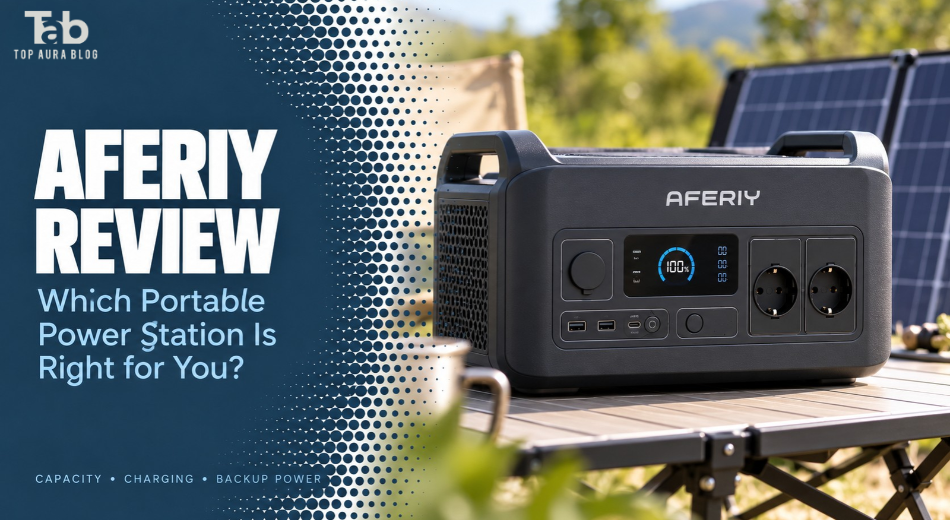
Official imagery shows self-contained stations with displays, controls, connection ports, and carrying provisions. The layout appears intended to keep power information visible while devices are connected, but photographs cannot establish handle comfort, screen readability outdoors, or the quality of buttons. Packaging protection and accessory completeness also require an actual delivery inspection. There is no unboxing experience implied in this review.
Before first use, match the supplied cables and accessories to your order, inspect for transit damage, and read the model’s manual. Keep the invoice, serial number, packaging, and photographs until you are satisfied everything works. Charge and test your intended appliances within the permitted operating conditions before depending on the station during an outage. Checking normal operation while mains power is available is much easier than troubleshooting an unfamiliar setup in the dark.
Performance and Practical Use: What the Numbers Really Mean
For any AFERIY solar generator review, the useful distinction is watts versus watt-hours. Watts describe the load being supplied at a moment in time; watt-hours describe stored energy. A 2,000W appliance consumes energy far faster than a 100W load, even when both fall within the inverter rating. High output can enable an appliance without making it economical to run for hours.
For illustration only, assume a 2,048Wh station delivers 85% of nominal energy through AC conversion. That gives approximately 1,741Wh, or about 8.7 hours at a constant 200W load before allowing separately for idle consumption and other conditions. A constant 1,000W load would reduce the same estimate to about 1.7 hours. These are planning calculations, not measured AFERIY results; actual efficiency, temperature, battery condition, and operating settings change the outcome.
Refrigerators add another complication because their compressors cycle and may demand a starting surge. Measuring energy use over a representative day is more useful than treating the appliance’s maximum label wattage as a constant load. For a router or other small device, check whether the station’s energy-saving settings could switch off a lightly loaded output. USB or suitable DC connections may avoid an AC conversion step, but only when the device and port specifications match.
AFERIY advertises rapid UPS switching on these models. That remains a manufacturer claim, not a guarantee that every computer, server, or sensitive appliance will remain uninterrupted. Test compatibility with non-critical equipment and use an appropriately specified backup solution for critical applications. Never improvise a connection that feeds a household socket backwards; fixed home integration needs suitable equipment and a qualified professional.
Solar input specifications deserve equal attention. The panel array must meet the station’s permitted voltage, current, connector, and wiring requirements, including open-circuit voltage under the expected conditions. A matching wattage label alone does not establish compatibility. Shade, panel positioning, weather, and simultaneous consumption can leave charging well below the advertised ceiling, so avoid planning around perfect solar production every day.
Pricing and Value for Money
The EU storefront displayed the following price indications during research. They are snapshots rather than guaranteed checkout offers, and bundles can cost considerably more than the base station. The P310 appeared at different prices across storefront surfaces, so a single definitive purchase price would be misleading. Confirm the selected variant, destination, taxes, delivery charges, and final total before making a comparison.
| Model | Displayed EU price indication | What to assess |
|---|---|---|
| P180 Pro | From €479 | Lowest capacity here; easier carrying |
| P210 | €729 | Fixed 2,048Wh configuration |
| P280 | €869 | Same base storage; expansion and higher input/output |
| P310 | €1,229–€1,424 across listings | Confirm base configuration and checkout price |
At these indications, the P280 costs €140 more than the P210. That premium buys capabilities rather than extra base battery capacity, making it easier to justify for expansion plans than for a small, unchanging load. Compare complete systems when shopping for solar: the battery, panels, compatible cables, delivery, and any expansion pack all belong in the total. A discounted base station is not necessarily the least expensive usable setup.
Purchase terms also affect value. The published warranty gives qualifying power stations a two-year base period plus a five-year extension requiring registration, with proof of purchase needed. The policy’s shipping table says customers bear both-way shipping after year two, even where eligible repair support remains. That distinction matters for heavy batteries: seven years of stated coverage should not be read as seven years without possible service expenses.
The EU return policy describes a conditional 30-day voluntary return window for deliveries within the EU. Personal-preference returns require the specified condition and completeness, and shipping or other eligible costs can apply. This is not a promise of a free extended home trial. Read the current policy and obtain return instructions, while remembering that the seller states applicable statutory rights remain unaffected.
Compare the Complete System Cost
Check the station, panels, delivery, and purchase terms together before deciding whether an offer represents good value.
Check AFERIY EU Prices →AFERIY Pros and Cons
| Advantages | Limitations |
|---|---|
| Models cover different carrying and storage needs | Larger models are heavy, especially the P310 |
| Expansion available on selected models | P210 capacity cannot be expanded |
| Higher-input options suit larger charging setups | Advertised charging ceilings are not everyday results |
| Published manuals and detailed purchase policies | Warranty extension requires registration; later shipping costs may apply |
| Potentially competitive displayed capacity pricing | No independently verified performance measurements in this assessment |
Who Should Buy AFERIY—and Who Should Avoid It?
AFERIY is most relevant to someone who can name the appliances they want to run and accept the practical work of managing stored energy. A weekend camper with modest loads has different needs from a household seeking several hours of essential-device backup. Choose the smallest system that meets a realistic energy budget with headroom, then decide whether expansion is worth paying for. That approach is more useful than buying the biggest inverter available.
| Buyer priority | Model to examine first | Main reservation |
|---|---|---|
| Regular carrying and modest energy use | P180 Pro | Half the base storage of P210/P280 |
| Price-conscious fixed-capacity backup | P210 | No expansion path |
| Future capacity growth and faster solar replenishment | P280 | Expansion packs increase total cost |
| Longer backup with infrequent relocation | P310 | 42kg listed base weight |
Skip these larger stations if you only need occasional phone charging or cannot safely move and store them. Buyers expecting electric space heating through a long outage should calculate the energy demand before ordering; high-wattage heat can exhaust a battery surprisingly quickly. Anyone needing guaranteed uninterrupted critical power, effortless whole-home integration, or locally available same-day repairs should investigate those requirements separately. A specification sheet cannot establish that level of service or suitability.
Customer Feedback: Is AFERIY Legit?
AFERIY has an operating regional storefront, product documentation, published policies, and public customer feedback. Those are useful signs of a functioning retail operation, but they do not prove that every order or warranty claim will go smoothly. “Is it legit?” and “Will this model meet my needs?” are different questions. Payment protection, clear seller identification, and keeping transaction records remain sensible parts of a substantial purchase.
Public AFERIY reviews include praise for delivery, perceived build quality, and helpful support, alongside reports of faults and dissatisfaction with communication or return handling. These are customer accounts rather than independently verified failure records. Different regional review profiles also cover different buyer populations, so a global score should not be treated as an EU-store reliability measurement. No reliable failure rate can be calculated from those comments alone.
AFERIY vs EcoFlow and Jackery
| Option | Published nominal capacity / rated output | Why compare it? |
|---|---|---|
| AFERIY P280 | 2,048Wh / 2,800W | Expansion path and high solar-input specification |
| EcoFlow DELTA 3 Plus | 1,024Wh / 1,800W | Smaller base-capacity alternative with expansion options |
| Jackery Explorer 2000 v2 | 2,042Wh / 2,200W | Similar nominal storage to P210/P280 for a complete-system comparison |
These are not interchangeable packages. The DELTA 3 Plus begins with roughly half the storage of the P280, so compare an expanded configuration if your runtime target requires it. The Jackery’s nominal capacity is closer, but output, charging connections, accessories, and purchase terms still need checking. There is no independently tested winner here; request the same delivered configuration from each brand rather than comparing unrelated promotional bundles.
Frequently Asked Questions
Is AFERIY worth buying?
AFERIY is worth shortlisting when its capacity, output, weight, and delivered price suit your needs. The strongest choice depends on your appliance energy use and whether expansion matters. This research does not establish measured efficiency or long-term reliability, so those remain limits to the recommendation.
What is the difference between AFERIY P210 and P280?
Both list 2,048Wh of base storage. The P280 adds higher rated AC output, a higher solar-input ceiling, and compatible battery expansion, while the P210 is not expandable. The P280 therefore offers more flexibility rather than automatically providing more runtime from its base battery.
Is the AFERIY P310 portable?
It is movable, but its listed 42kg weight makes frequent carrying demanding. Assess steps, vehicle loading, and the route to its storage location before buying. It is more convincing for occasional relocation than for buyers expecting easy daily solo lifting.
Does the P180 Pro support expansion batteries?
The EU Nomad1800 Pro listing specifies compatible expansion up to 5,120Wh total. Additional batteries are separate purchases and add weight. Confirm the exact Pro model and supported battery rather than assuming similarly named products share the same expansion capability.
Can an AFERIY power station run a refrigerator?
Potentially, if the running demand, starting surge, and connection requirements are compatible. Runtime depends on actual energy use and operating conditions. Measure consumption over a representative period and allow headroom instead of relying on a generic refrigerator runtime claim.
Are solar panels included with AFERIY power stations?
Do not assume they are. A base station and a solar-generator bundle can contain different items, and panel quantity or wattage may vary by selection. Check the contents, necessary cables, and electrical compatibility for the exact configuration before ordering.
How long does an AFERIY battery last on one charge?
There is no single runtime figure. Divide estimated usable energy by your average load, then allow for conversion losses, idle consumption, temperature, and changing demand. The calculations in this review are planning examples, not measured results for an individual station.
Does AFERIY offer a seven-year warranty?
The published EU policy gives qualifying power stations a two-year base warranty and a five-year extension requiring registration. Eligibility, exclusions, and shipping conditions apply, including customer shipping costs after year two under the policy table. Keep proof of purchase and read the current terms.
Can I return an AFERIY station after trying it?
The EU policy describes a conditional 30-day voluntary return window, not an unrestricted free trial. Personal-preference returns depend on condition, completeness, and the stated cost rules. Ask for return instructions and check the current policy before using the product as a trial purchase.
Can AFERIY replace a whole-home backup system?
A portable station can supply compatible individual appliances within its limits, but that does not make it a whole-home installation. Fixed integration requires appropriate equipment and professional assessment. Never connect it to feed a household wall socket backwards or assume its advertised UPS mode suits every critical load.
Final Verdict: Is AFERIY the Right Power Station for You?
AFERIY offers a credible shortlist for buyers prepared to match specifications to a real energy budget. The P210 is the simpler fixed-capacity proposition; the P280 deserves attention when expansion and charging flexibility matter. The P180 Pro is the more manageable carrying option, while the P310 trades substantial weight for greater stored energy. None becomes the best buy solely because of a large advertised discount.
The remaining uncertainties are meaningful: this review does not verify usable capacity, fan noise, surge handling, or repair turnaround. Compare the final delivered price with current alternatives, read the service terms, and test your intended loads before relying on the unit. The overall assessment is conditionally positive for informed buyers, with a numerical rating withheld until performance can be measured.
Choose Around Your Actual Power Needs
Review the exact EU specifications and purchase terms, then select a configuration that fits your load, charging access, and carrying limits.
Explore AFERIY Power Stations →