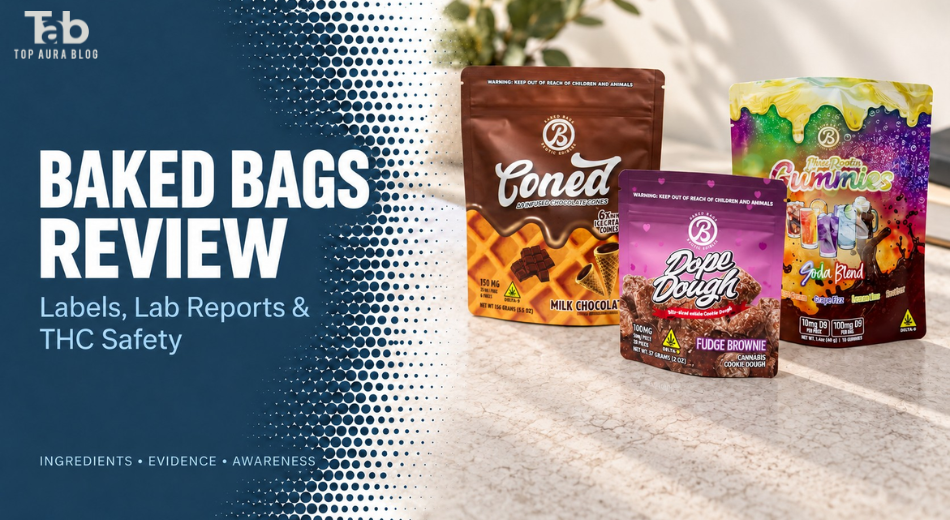
The first question about a THC-infused snack should concern its label, not its flavor. Familiar-looking food can make the contents seem ordinary, even when it contains an intoxicating substance. Brand names, ingredient statements, laboratory records, and customer comments each provide different information. None should be mistaken for a complete assessment of safety.
This Baked Bags review examines the information available about its gummies, Dope Dough, and Coned products. It addresses what the brand discloses, how to interpret a certificate of analysis, and why retailer credibility is a separate question from product composition or legality. The aim is independent consumer education, without product rankings, purchase recommendations, or claims of personal testing.
Research was checked on October 20, 2026, using the brand’s public pages, two linked laboratory documents, external customer feedback, and FDA and CDC guidance. No samples were consumed or independently analyzed. Statements about the business and its products are identified according to their source, and customer allegations are not treated as established findings.
The Main Findings
Public information: Baked Bags publishes product descriptions, a laboratory-report directory, and written policies.
Important limitation: Some directory entries have no report available, and a linked report must still be matched to the actual package.
Customer feedback: External reviews raise service concerns but cannot establish a product’s chemistry.
Safety: Hemp-derived THC can be intoxicating. No numerical quality or effectiveness score is assigned.
Understand the Risks of Edibles
CDC guidance explains why familiar food formats can carry delayed and unpredictable effects. It is a useful reference when interpreting any edible-product review.
Read CDC Edible Safety Guidance
What Is Baked Bags?
Baked Bags is a branded retailer of hemp-related edible products. Its public catalog includes gummies, dough-style bites, confectionery cones, and other snack formats. The website identifies Baked Bags LLC in its footer and publishes contact and policy information. Those details support identifying a public-facing business, but they are not an independent audit of ownership, manufacturing, or regulatory compliance.
The brand’s food-centered presentation is an important part of understanding it. These are not ordinary grocery products simply because they resemble familiar snacks. A product’s design and flavor tell readers little about its cannabinoid content. The more useful assessment follows the exact label, formulation, batch identifier, and supporting documentation.
This distinction also prevents a common review error: judging the entire catalog as though every product has the same composition. A named flavor can exist in different versions over time. A search result, old customer photograph, or previous report may describe a formulation that differs from the package someone currently has.
Baked Bags Gummies Reviews: Start With Product Identity
The public catalog and report directory identify several gummy products and distinguish between different cannabinoid descriptions. That makes the exact product identity essential. “Gummies” is a food format, not a complete chemical specification. Similarly, a flavor name is not enough to connect a package to a laboratory document.
For documentary purposes, read the product name, cannabinoid identification, batch or lot code, and ingredient statement together. Keep the original packaging rather than separating a product from its identifying information. If the package and web description disagree, the discrepancy needs a clear explanation; a reviewer should not silently choose whichever version sounds more reassuring.
There is no taste assessment here. Statements about sweetness, texture, aftertaste, or consistency would require actual sensory testing. Even a reliable taste description would not confirm the label’s accuracy or the absence of contaminants. Readers comparing Baked Bags gummies reviews should ask which part of the assessment is subjective and which part is documented.
Dope Dough and Coned: Familiar Food Requires Clearer Boundaries
Dope Dough is presented as a dough-style edible, while Coned uses a confectionery-cone format. Their relevance to this guide is the labeling challenge created by recognizable foods. A small baked-style item can contain an intoxicating ingredient without looking visibly different from a non-infused snack. That makes clear identification and separation from ordinary food particularly important.
The reviewed Dope Dough page lists milk, soy, and wheat and gives a facility-related allergen warning. Those declarations apply to the reviewed listing, not necessarily every flavor, batch, or future formulation. A severe allergy should never be assessed from a general brand review. The exact package and current manufacturer information are the relevant references.
For Baked Bags Dope Dough reviews and Baked Bags Coned reviews, physical condition is a different issue again. Broken pieces, damaged packaging, or a mismatch with the label may justify documenting a concern, but appearance alone cannot measure cannabinoid distribution. Neither a neat shape nor a familiar flavor is evidence of uniform composition.
Reading the Label Without Turning It Into a Use Recommendation
A package may describe cannabinoid content per piece, per stated serving, or across the entire container. Those are different units of information. Misreading the package total as a per-piece figure, or the reverse, can create a serious misunderstanding. This article does not convert those figures into suggested amounts to consume.
The identity of the cannabinoid matters too. Delta-8 and delta-9 terminology should not be collapsed into a generic “hemp” label. FDA guidance explains that delta-8 is psychoactive and that hemp terminology can mislead people who associate it with non-intoxicating products. A brand description should make the identity clear rather than rely on a reassuring plant-origin phrase.
A percentage and an absolute quantity also describe different things. Percentage is a concentration measure; a package quantity describes an amount in the stated unit. A low-looking percentage is not a personal safety classification. Neither number establishes how a particular person will respond, and neither substitutes for current official rules on the product category.
| Label element | What it describes | What it cannot establish |
|---|---|---|
| Cannabinoid name | The substance the seller says is present | That it is non-intoxicating |
| Per-piece statement | Declared content associated with one item | Uniformity without relevant supporting analysis |
| Package total | Declared amount across the container | An appropriate amount for an individual |
| Ingredient and allergen statement | Listed food components and warnings | Suitability for every dietary restriction |
| Lot or batch identifier | A route to traceability | Composition without a matching report |
Lab Reports: A Useful Disclosure With Important Limits
Baked Bags provides a public certificate-of-analysis directory organized by product category. When checked, it linked documents for several products while marking some limited-release popcorn entries as having no lab result available. The absence of an online document is a transparency gap, not proof of contamination. It means a relevant result was not available through that directory entry at the time reviewed.
Two linked documents were examined for this guide: a Chocolate Chip Dope Dough report identifying SC Labs and a Milk Chocolate Coned report identifying ACS Laboratory. Both identify particular samples and batch information. Their presence is more concrete than an unsupported laboratory badge, but neither can be assumed to describe a package that has not been matched to the report.
The Dope Dough document carries a June 2026 issue date. The Coned document identifies a December 2025 batch and an early-January 2026 original completion date. Those dates illustrate why age and batch identity need attention. A report can be genuine and informative while still being irrelevant to a differently labeled or later production lot.
Start with the sample name, lot or batch code, dates, and laboratory identity. Check the units in each results column and distinguish measured values from reporting limits. If a document uses abbreviations such as “not detected” or “below quantification,” read its definitions. Those terms describe analytical limitations; they should not be casually translated into an unlimited absence claim.
Documents reviewed: Chocolate Chip Dope Dough laboratory document · Milk Chocolate Coned laboratory document.
Potency Testing, Contaminants, and Clinical Evidence Are Different
A cannabinoid panel and a contaminant panel answer different questions. A document may measure listed cannabinoids without examining every pesticide, solvent, metal, or microorganism. Equally, a passing contaminant result applies to the substances and limits actually tested. Read the complete scope rather than treating a single summary word as a universal guarantee.
The Coned document reviewed includes reported results for heavy metals, pesticides, residual solvents, and microbiology, alongside potency information. It also limits its conclusions to the analyzed material and specified testing scope. This is a report-specific observation, not a certification of the entire catalog or every item carrying the same commercial name.
Analytical documentation is not evidence that a product treats insomnia, anxiety, pain, or another condition. Laboratory testing can describe a sample without establishing a medical benefit. Likewise, a customer’s report of feeling relaxed cannot authenticate the contents of a package. Keeping chemistry, personal experience, and clinical effectiveness separate produces a more useful assessment.
| Evidence type | Useful for | Main limitation |
|---|---|---|
| Product label | Identifying the seller’s declarations | It is not an independent measurement |
| Batch-matched COA | Understanding the tested sample and scope | It does not certify all products or future batches |
| Customer feedback | Learning about reported service and experiences | It cannot establish causation or chemical composition |
| Clinical research | Evaluating defined health questions | Findings may not apply to this commercial formulation |
THC Effects and the Limits of Edible-Product Reviews
CDC warns that edible effects may be delayed and can last longer than expected. Their unpredictability is part of the safety issue, especially when someone assumes an ordinary-looking snack will behave predictably. Reports about another person’s timing or experience should not be used as a timetable for oneself.
FDA states that delta-8 products have not been evaluated or approved for safe use in any context and describes concerns about labeling, variable formulations, and possible manufacturing contaminants. These are category-level concerns, not findings that a particular Baked Bags item contains a specific contaminant. They show why plant origin and retail availability are insufficient grounds for a safety conclusion.
A responsible Baked Bags delta 9 review also needs to avoid treating intensity as a quality score. Stronger effects are not evidence of better manufacturing or suitability. Conversely, someone reporting little effect has not performed a chemical analysis. Product reviews are most informative when they describe their methods and limits rather than converting subjective intensity into a recommendation.
Separate Hemp Terminology From Safety Evidence
The FDA’s consumer update explains concerns about delta-8 products and why “hemp” does not necessarily mean non-intoxicating.
Read the FDA Consumer Update
Household Storage, Driving, and People Who Need Particular Caution
CDC recommends keeping cannabis products in a locked childproof container, out of sight and reach of children and pets. Food-like presentation makes that separation particularly important. Preserve identifying packaging and keep infused products away from shared snacks. A household member should not have to recognize a brand name to avoid an unintended exposure.
Cannabis can impair reaction time, coordination, judgment, and perception, according to CDC. Do not drive or operate machinery while impaired. Combining cannabis with alcohol can increase impairment, and another person’s claim that they felt normal is not evidence of driving fitness. There is no universally reliable waiting period supplied by this guide.
CDC recommends avoiding cannabis during pregnancy and encourages breastfeeding people to avoid it as well. Anyone using medicines or seeking help for a health concern should discuss substance use with a qualified clinician. Commercial testimonials cannot replace an individualized assessment, and a product’s availability does not make it an appropriate substitute for treatment.
If accidental exposure is suspected, seek prompt advice from an appropriate local poison-information service or healthcare professional. Difficulty breathing, collapse, or inability to wake someone requires emergency medical assistance. For a child or pet, do not wait for a brand representative to reply before seeking help. Keep the package available for the professionals assessing the situation.
Health references: CDC poisoning guidance · CDC driving guidance · CDC pregnancy and breastfeeding information · Poison Control accidental-exposure guidance.
Baked Bags Reviews: What Customer Feedback Actually Shows
The Trustpilot page for www.bakedbags.com displayed 36 reviews and a 1.9/5 score when checked. The small sample and the platform’s note about representativeness matter. Those figures describe a public-review page at a point in time, not a measured rate of successful deliveries or satisfied customers across the business.
Visible complaints concern delayed or missing deliveries, refund disagreements, support, and billing questions. Positive accounts describe received products and favorable taste impressions. At least one reviewer questions whether some complaints concern impersonating sites; that is a reviewer’s interpretation, not an explanation independently established here. No individual allegation was verified through order records.
For the question “is Baked Bags legit,” separate business visibility from transaction handling and product verification. A recognizable storefront and laboratory documents can coexist with service complaints. Neither favorable testimonials nor an unfavorable aggregate score determines the composition of a particular item. The available evidence supports specific questions, rather than a blanket declaration that every transaction is safe or fraudulent.
External customer-feedback source.
Refunds, Billing, and Documenting a Concern
The published refund policy says refunds are generally unavailable after an order is placed, but it also describes case-by-case resolutions and the process if a refund is approved. It excludes certain non-returnable goods, including perishables, and says exchanges are not offered. For damaged, wrong, or missing items, it asks customers to provide order details and photographs or video.
Those terms should not be summarized as an unconditional satisfaction guarantee. Keep the order confirmation, applicable policy, package photographs, and correspondence together when documenting an existing problem. An accurate chronology helps separate dispatch, carrier scans, delivery, and the company’s proposed resolution. A tracking label alone does not establish that a package was delivered.
Billing concerns should likewise be assessed from records rather than inferred from a complaint headline. Check whether the confirmation identifies a one-time charge or recurring arrangement and retain any cancellation acknowledgement. This review did not verify a current subscription contract or establish that all transactions involve recurring billing. Uncertainty should be stated plainly instead of converted into an accusation.
Legal Claims Need an Independent Reference
The storefront makes broad claims about hemp legality and also uses deadline-based legal messaging. This guide does not adopt those messages as legal advice. A retailer’s interpretation may be incomplete, outdated, or focused on only one part of a regulatory framework. Legal status must be checked against current official rules for the specific product and jurisdiction.
Different questions can arise around possession, food ingredients, manufacturing, sale, transport, and import. Permission in one context does not answer all the others. A laboratory percentage or a shipping option is not a universal legal clearance, and a brand’s age gate is not an individualized assessment of lawful access.
Cross-border assumptions are particularly unreliable. Do not infer that a product permitted somewhere in the United States can be imported into another country. Seek current information from the relevant regulator or a qualified legal professional when the rules are unclear. No jurisdiction-specific legal conclusion or method for bypassing restrictions is offered here.
A Balanced Assessment of the Public Information
| Useful public information | What remains unresolved |
|---|---|
| A named company and published contact information | Independent verification of the whole supply chain |
| A searchable laboratory-document directory | Whether every current package has a matching report |
| Accessible sample-specific COAs | Composition of untested or unmatched items |
| Published refund language | How an individual complaint will be resolved |
| Customer feedback from multiple perspectives | The overall rate of failures or successful outcomes |
Frequently Asked Questions
What does this Baked Bags review assess?
It examines publicly available product information, labeling, selected laboratory documents, customer feedback, and THC safety considerations. It does not provide firsthand taste testing, independent chemical testing, purchase recommendations, or a medical endorsement.
Is Baked Bags legit?
Baked Bags has a public-facing storefront, company information, and linked laboratory records. External feedback also raises service concerns. These facts should be evaluated separately; they do not establish that every transaction is satisfactory or every product claim is independently verified.
Are Baked Bags edibles ordinary snacks?
No. Familiar food formats can contain intoxicating cannabinoids. A product’s flavor or appearance does not reveal its contents or establish safety. Keep identifying packaging and separate infused products securely from ordinary household food.
What should I look for in Baked Bags gummies reviews?
Distinguish reports about taste or customer service from evidence about composition. A reviewer’s personal experience cannot verify a batch’s contents or predict another person’s response. Exact product identity and matching laboratory documentation are more relevant to label verification.
Do Dope Dough products have allergen warnings?
The reviewed Dope Dough listing declares milk, soy, and wheat and includes facility-related allergen information. Do not apply that summary to every flavor or formulation. Someone with an allergy needs the exact current label and appropriate professional advice if uncertainty remains.
Does a COA prove every Baked Bags product is safe?
No. A certificate of analysis concerns a specified sample and the measurements performed. It must be matched to the relevant product and batch. It does not establish universal safety, clinical benefit, or identical composition across all future production.
What if a product has no laboratory report listed?
The absence of a public report is a documentation gap rather than proof of contamination. In this guide, some directory entries were marked as having no report available. Without relevant documentation, an independent conclusion about that batch’s composition cannot be made.
Does hemp-derived mean non-intoxicating?
No. Hemp terminology does not guarantee an absence of intoxicating THC. FDA guidance specifically warns that some hemp labeling can create misleading expectations about delta-8 products. Read the actual cannabinoid identification rather than relying on plant-origin language.
Can THC edibles affect driving?
Yes. CDC explains that cannabis can impair reaction time, coordination, judgment, and perception. Do not drive while impaired. Another person’s reported experience, an elapsed-time estimate, or a familiar food format cannot establish that someone is fit to drive.
What should I do if a child accidentally eats a THC product?
Seek prompt help from an appropriate local poison-information service or healthcare professional. If there is difficulty breathing, collapse, or inability to wake the child, contact emergency medical services immediately. Keep the packaging available and do not wait for customer support.
Conclusion: Specific Evidence Matters More Than a Brand Verdict
Baked Bags provides more than a product name: its public pages include ingredient information, policies, and a directory of laboratory documents. Those disclosures are useful, but their value depends on relevance to the exact item and batch. Missing documentation and unresolved customer concerns should remain visible in any independent assessment.
The fair conclusion is limited. There is enough public information to examine the brand’s claims, but not enough in this review to certify its entire catalog, establish medical benefits, or predict an individual experience. No numerical rating is assigned. Clear labeling, relevant analytical records, current official guidance, and careful handling provide a more defensible framework than a promotional “worth it” score.
Use Independent Health Information as the Reference Point
For questions about edible effects, household exposure, and poisoning risks, consult public-health guidance and qualified local professionals.
Review CDC Cannabis Information